
161: The Rise of Hybrid Capital
Introduction: The Shift Is Already Underway
Traditional venture capital has long operated on a familiar model: deploy equity, pursue growth, and target an exit. But in today’s environment—defined by tighter capital markets, longer exit timelines, and increased scrutiny on profitability—that model is being re-engineered in real time.
What’s emerging is a more nuanced, performance-oriented approach: hybrid capital, where capital deployment is directly integrated with revenue generation.
This is not theoretical. It’s already reshaping how sophisticated investors—and the companies they back—think about growth.
What Is Hybrid Capital?
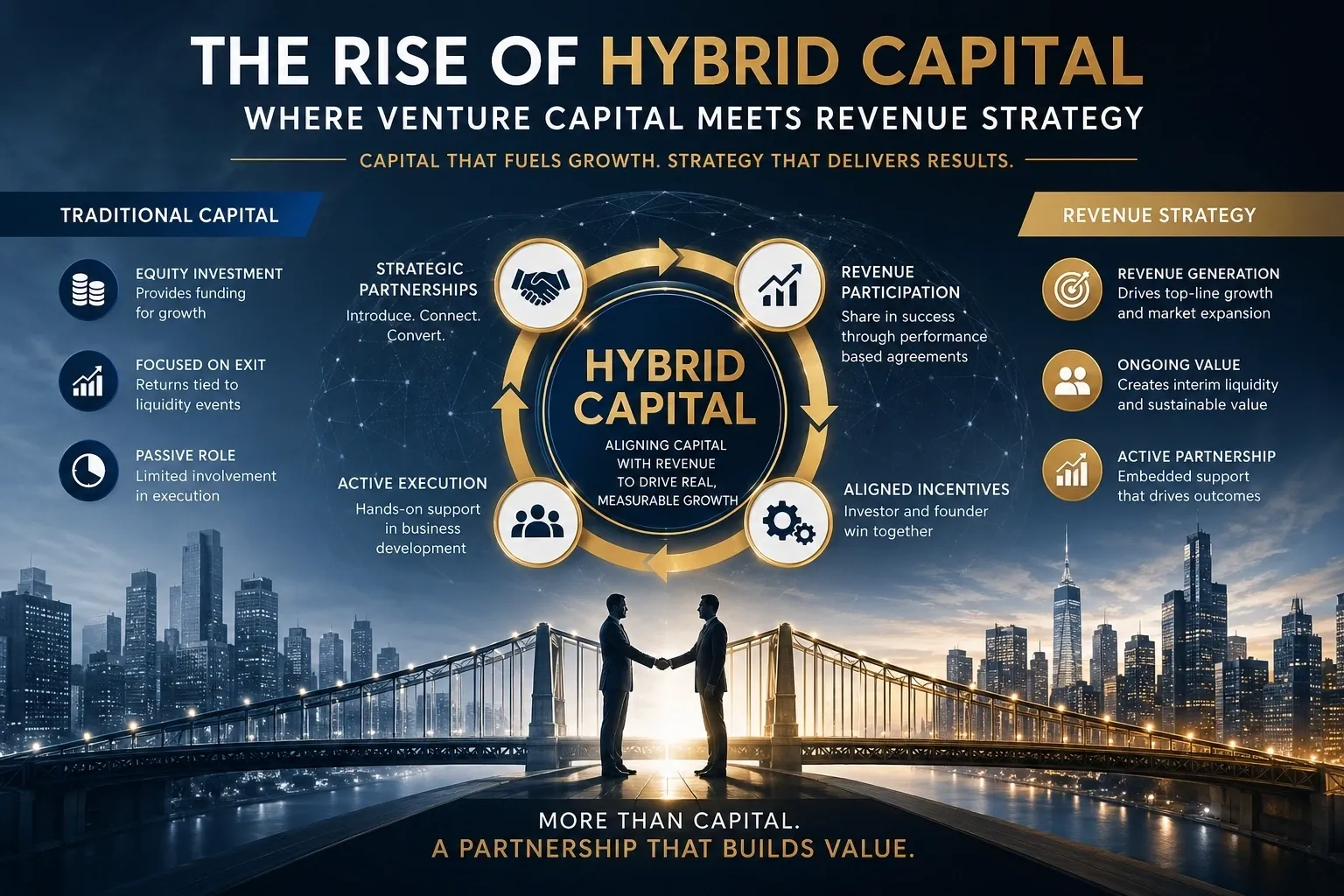
Hybrid capital blends equity investment with revenue participation mechanisms and active business development execution.
At its core, it answers a simple but critical question:
What if capital didn’t just fund growth, but actively drove it?
Instead of waiting for outcomes, hybrid models participate in creating them.
Key components include:
- Equity investments aligned with long-term upside
- Revenue-sharing agreements tied to actual performance
- Strategic introductions that convert into measurable revenue
- Embedded operating support, not just advisory
This model transforms capital from a passive asset into an active growth engine.
Why This Model Is Gaining Traction
There are three structural forces accelerating this shift:
1. Capital Efficiency Is Now Paramount
Growth-at-all-costs has been replaced with disciplined scaling. Companies are expected to demonstrate traction, not just potential.
2. Exit Timelines Are Extending
With IPO markets less predictable and M&A cycles elongating, investors are seeking interim liquidity mechanisms; revenue participation fills that gap.
3. Founders Want More Than Capital
The best founders are no longer asking, “Who can fund us?”
They’re asking, “Who can help us win?”
Hybrid capital directly addresses that need.
From Theory to Execution: Where Most Get It Wrong
Many firms attempt to position themselves as “value-add investors.” Few actually operationalize it.
The difference comes down to execution discipline.
Common pitfalls:
- Vague promises of “introductions” without accountability
- Misaligned incentives between investor and company
- Lack of infrastructure to support business development at scale
What works instead:
- Defined revenue participation frameworks
- Clear KPIs tied to investor-driven growth initiatives
- Systematic pipelines for partnerships, distribution, and channel expansion
In other words, structure beats storytelling.
The Strategic Advantage: Alignment at Every Level
Hybrid capital creates a level of alignment that traditional models struggle to achieve:
Stakeholder Traditional VC Model Hybrid Capital Model
| Stakeholder | Traditional VC Model | Hybrid Capital Model |
|---|---|---|
| Investor | Exit-driven returns | Exit + ongoing revenue participation |
| Founder | Dilution + pressure | Growth support + aligned incentives |
| Company | Capital infusion | Capital + revenue acceleration |
The result is a more resilient growth trajectory and less dependence on external market timing.
Where This Model Excels
Hybrid capital is particularly effective in:
- B2B companies with defined sales cycles
- International firms entering the U.S. market
- Businesses with strong products but underdeveloped distribution
- Companies seeking strategic partners, not just investors
In these environments, execution and not just capital is the constraint.
A New Standard for Venture Capital Consulting
This shift also redefines the role of venture capital consultants.
The old model:
- Prepare pitch decks
- Make introductions
- Advice on fundraising
The new model:
- Architect capital structures
- Drive revenue through strategic relationships
- Participate in outcomes, not just processes
This is where venture capital consulting evolves from advisory to embedded growth partnership.
Final Thought: Capital Should Be Accountable
We are entering an era where capital is no longer judged solely by where it is deployed but by what it actually produces.
Hybrid capital represents a fundamental shift toward accountability, alignment, and execution.
And in a market where outcomes matter more than narratives, that shift is not optional; it’s inevitable.
Stay tuned for next week’s post. If you have any questions or need personalized venture capital consulting, feel free to reach out to info@invisionate.com.